We Counted What We Waste
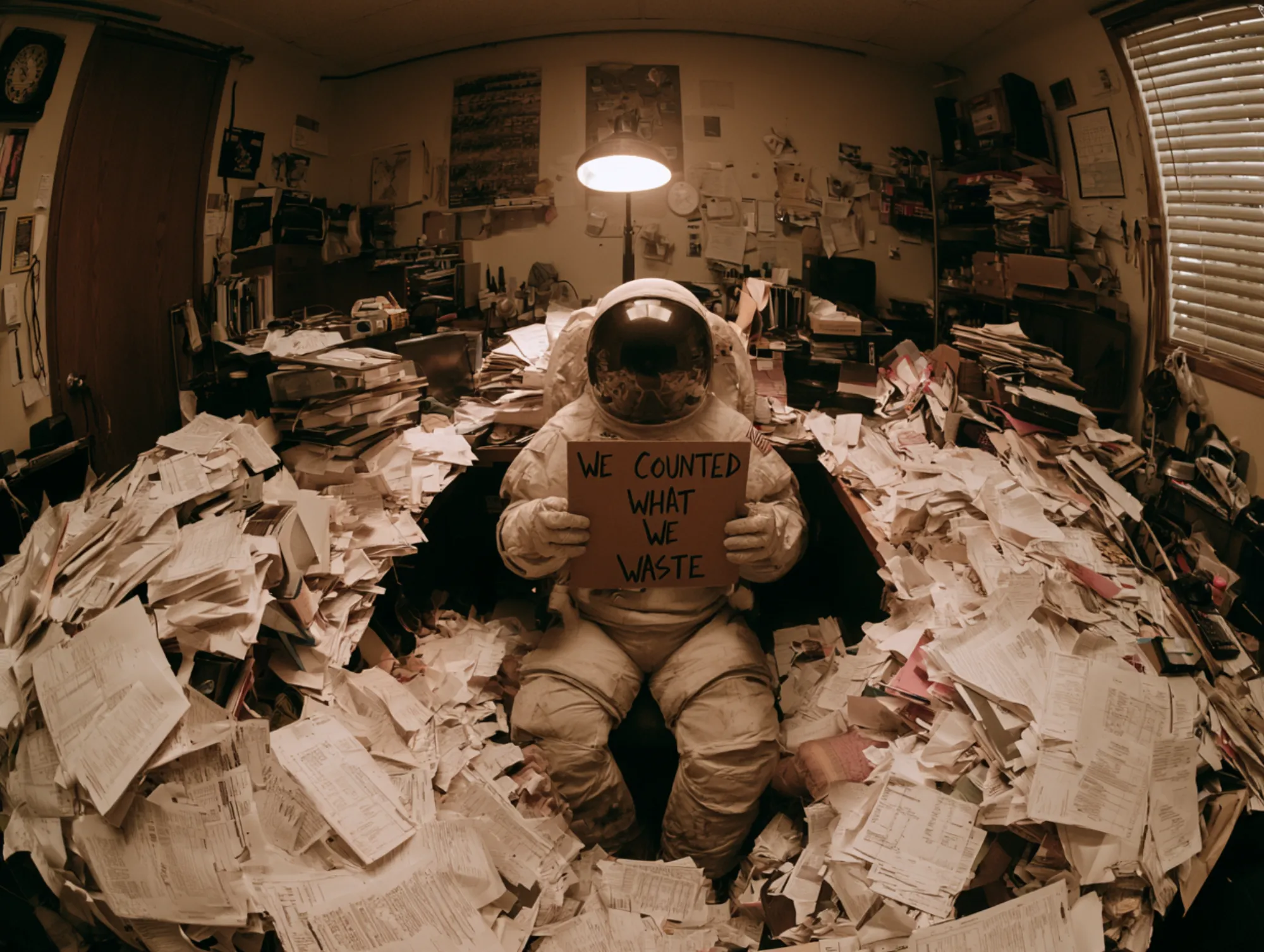
Part 2 of a series on how a studio rebuilds the way it works from the ground up.
Last time I told you about the four-tool workflow we'd built for client intake, and the night I finally saw it for what it was. But "it felt like a lot of wasted time" is not a reason to rebuild how your studio works. Feelings are cheap. Rebuilding is expensive.
So before I touched a single line of new code, I did something I should have done months earlier. I sat down and actually counted.
What I found was worse than I expected, and not in the way I expected. The counting started with one workflow. It did not stay there.
Line one: the hours you can see
Start with the obvious one, because it's the easiest to measure and the easiest to underestimate.
I took one client project from first contact to closing and timed every manual handoff. Reading the intake response and shaping it into usable notes. Copying the details into a proposal. Building the proposal. Writing the contract and pasting its terms back out of the proposal. The closing paperwork at the end. For us, that came to roughly 50 minutes of pure copy-paste and reformatting per project, work that produced nothing new, just moved existing data across a wall.
50 minutes sounds harmless. Multiply it. At 20 projects a month, that's nearly 17 hours. Call it two full working days a month, every month, spent being a courier for our own data.
Here's the trick most people miss when they do this math: they price those hours at minimum wage in their head. Don't. Price them at what that time is actually worth. That's senior studio time being spent on a task a temp couldn't legally get wrong. The real cost isn't the hours. It's the hours times what you could have built instead.
These start on our numbers from the article. Drag them to your own and watch the year add up.
And this is only line one — the hours you can see. The article covers the three lines that cost more.
Line two: the hours you can't see
The visible time is the cheap part. The expensive part is what goes wrong in the gaps.
Every manual handoff is a place where a digit gets dropped, a stale number survives from an old version, a record slips between two apps and nobody notices. We had a real one: a record fell through the crack between two tools, and we found out from the client, not from ourselves. You can't put a clean number on that, but you know exactly what it costs, because you've felt it. It's the half-day of cleanup. It's the apology email. It's the small, permanent dent in how seriously a client takes you afterward.
Errors in a manual pipeline aren't a bug you can patch. They're a baseline. The question is never whether one slips through, only how often and how bad.
Line three: the moment the count got out of hand
Here's where I expected to stop. I had a workflow, I had its cost, the math was damning, case closed.
Except once you start counting leaks, you can't stop seeing them.
Because the same week I was timing the intake workflow, I went looking for how many hours the team had logged on a project, and the answer lived in a spreadsheet someone updated by hand. I went looking for what we'd invoiced a client this quarter, and that was a different spreadsheet. Who was on leave next week was in a third place. What we actually knew about a recurring client, the context, the past decisions, the gotchas, lived in people's heads and a graveyard of old documents. Which password opened which client account was a pinned Slack message nobody trusted. The status of a project was wherever the person running it happened to keep it.
It was the exact same disease. Not a metaphor for the same disease. The same one. Data scattered across tools and spreadsheets and heads, with a human standing in every gap, carrying it across by hand, and a quiet error baseline on every single trip.
The intake workflow wasn't the problem. It was just the symptom loud enough to make me look. And once I looked, I couldn't find a corner of the studio that wasn't bleeding the same way. Time. Money. People. Knowledge. The thing I thought was one leaky pipe was the whole house, leaking from every joint, and I'd just gotten used to the sound.
Line four: the most expensive line of all
And then there's the one I wrote about last time, the one that started this whole thing.
As long as the data lived everywhere and nowhere, AI couldn't touch the actual work. The leverage everyone else was starting to get, we structurally could not get, no matter which model we paid for. You can't point intelligence at a business whose knowledge is smeared across forty places. So the cost of staying scattered wasn't just the time it burned today. It was every future efficiency it locked us out of, for as long as it stayed scattered.
There's a human version of this line too, and it's the one that finally got me out of the chair. When your people spend their days being couriers, that's the most capable, most expensive, most creative time in the building, spent on the one task that requires none of those things.
Adding it up
Put the lines together and the number stops being abstract. The visible courier hours, priced honestly. The error baseline on every handoff. The AI leverage locked behind the walls. The talent burning on busywork. And all of it multiplied, because it wasn't happening in one workflow. It was happening in every part of the operation at once.
When I finally had that total in front of me, the question flipped. The expensive option was no longer "rebuild how the studio works." The expensive option was keep doing this. Rebuilding stopped looking like a risk and started looking like the only sane move on the table.
It helped that we wouldn't be starting from zero. Years of building design systems had trained us to think in single sources of truth, and we already had solid, modular code foundations to build on rather than a blank file. The rebuild was a big bet, but it was a bet placed on ground we'd spent years preparing without realizing it. More on why that mattered so much in the next post.
That's the moment a workflow fix turned into something much bigger. I didn't set out to rebuild the whole operation. I set out to fix an intake form, did the math, and discovered we'd been running the entire studio on the same broken pattern without ever naming it.
So I knew it all had to change, and I knew roughly what it had to become: one place, one source of truth, every part of the business sitting on top of it. But knowing what you need and knowing how to build it without recreating the same trap in a bigger shape are very different problems.
Next time: the first thing we got wrong when we tried to build it, and the principle we had to commit to before any of it made sense.